

BC HOUSING STILL TURNING DOWN.....
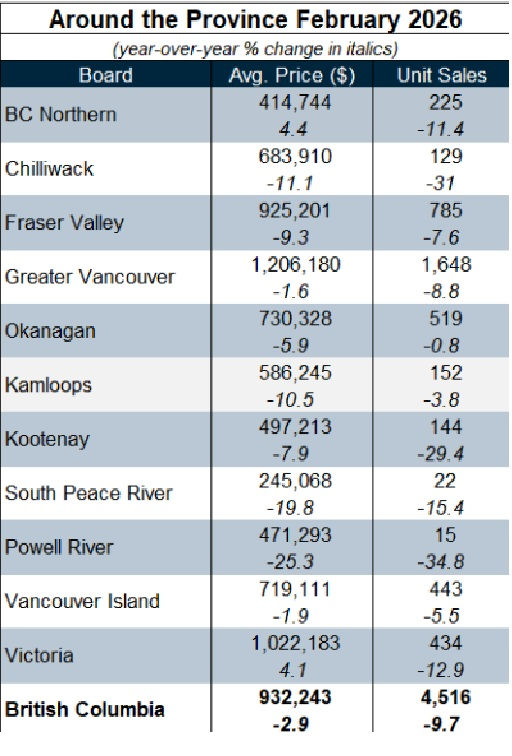
British Columbia Housing Market Continues to be Sluggish.....
Just when consumers seem ready to step off the fence, another wave of economic or real estate negativity hits. In late 2024 and early 2025, it looked like we were moving into recovery mode. Then a global tariff war rattled consumer confidence. Over time, people started to get used to it—or maybe just tired of hearing about it—and activity began to pick up again. But then in early 2026 the war in the Middle East pushed people right back into worry mode. This ongoing uncertainty, combined with factors like the federal ban on foreign buyers, the speculation and vacancy tax, and restrictions on short-term rentals, has kept both Canada and British Columbia in a negative mindset when it comes to investment. As a result, many people are holding off on making a move. The Lower Mainland is noticeably less active than the Interior, with prices slowly inching down in what is clearly a buyer’s market—or a correction. The Interior is holding up slightly better, but still sitting at the lower end of a balanced market. I still believe 2026 will bring some positive news by the end of the year—but so far, that prediction hasn’t materialized.

Good News Bad News for the Rental Market in BC…
Rents are down in most areas of Canada. British Columbia leads the country with a 4.9% reduction of average provincial rental decline. Rents dropped 4.7-percent in Ontario, 4.6-percent in Alberta, and 3.1 percent in Quebec. This is good news for tenants and bad news for landlords. Rents are actually up slightly in Saskatchewan, Manitoba and Atlantic Canada. Apartment and condominium asking rents in B.C. are now down 11.8 percent from their peak in September of 2023. The number of newly completed apartment units was up 56% in 2025 in BC compared to 2024. That increase in inventory is the main cause of the rental adjustments.

You cannot write a contract to Override a Statute.
This is one of the most misunderstood principals in the Real Estate industry. Many people believe that if two parties agree to something in writing, that makes it enforceable. That is not not necessarily true.
If a contract term conflicts with mandatory legislation — such as the Residential Tenancy Act, the Strata Property Act, or the Real Estate Services Act here in BC — the statute wins. Period. Courts will simply strike out the offending clause and apply the law/statute instead.
You can be creative in drafting. You can negotiate. You can structure deals in sophisticated ways but you cannot override a statute or common law. Understanding the difference between what is negotiable and what is not is what separates experienced professionals from amateurs.
Here are a couple examples. A landlord wants a full month's rent as a security deposit. The Residential Tenancy Act (RTA) says the maximum is a 50% deposit. The RTA wins. The clause outlining the full month's rent as a security deposit would be unenforceable. Another example with the RTA is if the landlord wants to be able to give 1 months notice if he wants to evict the tenant for his own use. The Statute (RTA) says 4 months notice. The Statute wins.
Another very interesting example is the Common Law principle of disclosure of Material Latent Defects (MLD). Many times REALTORS® or even lawyers will claim they do not have to disclose a "known" MLD because they have used the verbiage "As is where is" in a contract". This phrase basically means you get whatever you get. However, if the seller was aware of a (MLD) like an illegal grow-op or asbestos or water damage no matter if the seller is a bank, lawyer or company or individual they are still obligated to disclose that MLD.
There are many examples of this in all types of Real Estate transactions. This is why it is vital to use a a REALTOR® who not only knows their stuff but more importantly knows when to say "I don't know " and reachs out and get legal advice.

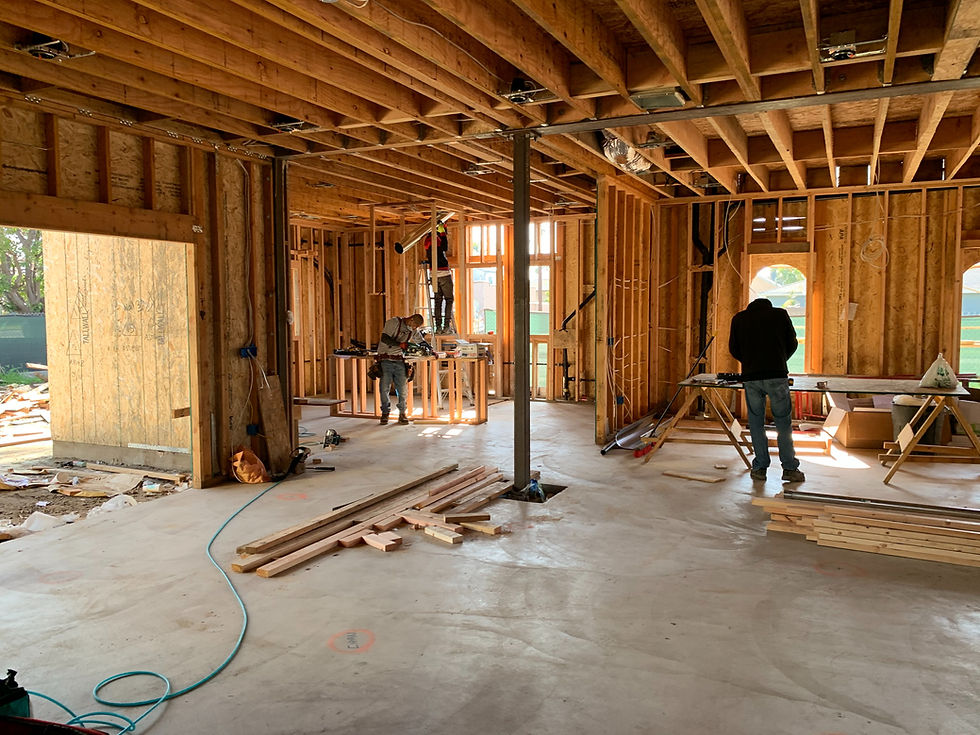
CMHC Housing Starts Will Slow over the Next 3 Years...
“We expect Canada’s economy to grow slowly in 2026, as many households and businesses remain cautious because of geopolitical and trade uncertainty,” Kevin Hughes, deputy chief economist at CMHC, said in a statement. “This caution is leading many households to delay buying homes and making builders more hesitant to start new projects.”
CMHC forecasts real GDP growth of just 0.7% in 2026 (1). High unemployment, modest income growth, slower population increases and mortgage renewals at higher rates are all expected to limit housing demand.
National home sales are projected to edge up in 2026, largely because Ontario and British Columbia are rebounding from especially weak levels. Even so, sales will remain below long-term norms. Prices are expected to stabilize nationally, though Ontario could see further declines in 2026 before a recovery begins in 2027.